This article is by Kate Elliott, and it is on Tor.com. It's as excellent as her previous writing on this topic.
Writing Women Characters into Epic Fantasy Without Quotas

Thursday, March 24, 2016

Sunday, March 20, 2016
Fantasy Novels I've Read Recently
We're already almost a quarter of a way through 2016, so I wanted to list some of the books I've read and enjoyed over the past two months or so. The last two, Updraft and Uprooted, were published in 2015 and are eligible for the 2016 Hugo Awards. If you're eligible to nominate for the Hugos this year (the March 31 deadline is rapidly approaching), I recommend you give these a read if you haven't already. I'd never tell anyone else what they should like, but I think both of these books are Hugo Worthy.
The other titles on this list are excellent too, and I strongly recommend them.
 |
| Cover by Todd Lockwood |
A Natural History of
Dragons by Marie Brennan. Tor 2013. I put off
reading this book, because I thought it was going to be a fake reference book
or something, but it's actually a delightful story, written memoir style, about
Isabel, a woman living in a quasi-Victorian world that is very similar to our
own, except that it has dragons. Fantasy elements are slight, and the dragons
portrayed are very naturalistic--intelligent animals. The book starts with a
the protagonist's childhood memories of dissecting a dead dove (and getting
punished for it) and collecting specimens, and nearly being killed by a
creature called a "wolf drake."
After Isabel marries a man with similar interests, she
manages to get them a berth on a research trip to a mountainous country to
study a breed of dragons called "rock wyrms." The narration is alive
with voice and the protagonist's wry wit, and the tale kept me riveted until
the end. I've just read the sequel, entitled The Tropic of Serpents, and it's every bit as good. These books definitely a change of pace from the style of epic fantasy I usually prefer, but I enjoyed them thoroughly and plan on reading the rest of the books in this series.
 |
| Cover by John Jude Palencar |
Broken Blade by
Kelly McCullough. Ace books, 2011. Aral, the
protagonist, is a former assassin priest of a goddess of justice who has been
murdered by her fellow deities. Robbed of both faith and identity, he's a
tattered remnant of his former self who works as a blade for hire between bouts
of drinking. The only thing keeping him sane is Tris, his shadow-dragon
familiar. I'm a sucker for "hot mess" characters and for stories with
animal companions and magical familiars, so this premise attracted my interest.
The author's wonderful deconstruction of the "trouble walked in wearing a
red dress" trope in the opening scene drew me in.
The book was entertaining, cleanly written, and well paced, and I liked the pov character's voice. If there's a flaw, it's that the author was a bit light on environmental and character detail for my tastes. I tend to favor leanness here, but I couldn't really visualize the kinds of clothes they were wearing, the style of architecture, and the appearance, coloring, racial characteristics of the characters, so my mind kept defaulting to "pseudo-medieval, European with everyone white," but I don't know if this was the author's intent. It's a small thing, though. This is the first book
in a series, and I look forward to reading the next one soon.
 |
| Cover by Kris Kamikakushi |
"Hunting Monsters" by S.L. Huang. Book Smugglers
Publishing 2014. This is a short story, published as
a stand alone. It's available as an e-book on Amazon, and Barnes and Noble
online. Set in a fairy tale world (incorporating elements from "Little Red
Riding Hood," "Beauty and the Beast" and other classic tales), this
is a wonderful example of how a good writer can layer world building and
history into a short story. Like many good fairy tale protagonists, the main
character lives in a small cabin in the woods. On her fifteenth birthday, her
mother is arrested for the murder of a grundwirgen, creatures that resemble
beasts but are people in the eyes of the law.
The writing in this story is very good. I've always had a
weakness for retellings and reinterpretations of fairy tales, and this one was
a page turner.
 |
| Cover by Steven Martiniere |
Updraft by Fran
Wilde. Tor Books, 2015. This has to be one of the
most unique speculative fiction settings I've ever encountered. Set in a world
where people live in bone towers (which appear to grow from somewhere below the
clouds) and fly on silk wings, it follows Kirit, a protagonist who wants to
become a trader like her mother, but is manipulated into becoming one of the singers
who protects her city safe from attacks by invisible predators.
As a singer in training, Kirit stumbles across multiple
layers of intrigue and discovers a truth that could change her world forever.
This story is fascinating and well written. If it has a fault, its that the
alien setting and culture, along with the highly immersive approach to world
building (it's told in a very "here and now" style of first person
with not an info dump in sight) makes it hard to understand and relate to the
characters' motives at times. This may be a fault in me as a reader and not the
book itself, however, and I found myself increasingly pulled in as I read. I
look forward to the sequel, which is coming out later this year.
 |
| Cover by Scott McKowen |
Uprooted by Naomi
Novik. Del Rey books, 2015. This story draws from
Polish fairy tales the author remembers from her childhood, and it's beautifully
written. Set in a village where a 17-year-old girl is taken every ten years by
the wizard who protects it from encroachment by a cursed wood, the story has a
strong female protagonist who is driven by her love for her best friend. The
world is vividly drawn and simultaneously familiar and relatable yet fresh with
many unexpected twists. I liked the way the author was able to create a sense
of menace while remaining basically optimistic about human nature. Kept me
guessing until the end.
This is a stand alone-novel, something that's probably too
rare in fantasy. I love series and I understand why writers and readers of
fantasy like sweeping epics and want to return to their favorite worlds for
tale after tale, but it's also pleasant to be able to lose oneself in a book
and to reach the end without feeling like there are plot threads that still
need to be tied off.
Sunday, March 6, 2016
Fantasy Novels Without War
Last
time, I wrote about the popularity of war as a plot element in fantasy, but
there are a number excellent novels that break with this tradition.
Before I can discuss this further, however, I have to define
what I mean by military plot elements. This is important, because different
readers may draw the line in different places, or differ in what they see as
militaristic. I mentioned last time that a friend and I disagree about whether
Anne McCaffrey's Dragonriders of Pern
books are, at their heart, military stories, because I see the combat between
the dragons and the thread as an "against nature" sort of context, but
he has a point when he says that the dragon weyrs have many of the characteristics
of a military, such as support via a system of tithes and a hierarchical rank
structure.
For this reason, I've attempted to separate these ostensibly
non-military fantasy novels into two broad categories: books where combat
itself plays no significant role in the plot at all, and books where there are
skirmishes and armed conflict at times, but it exists in a context that is
personal or disorganized. In both cases, any "action," such that it
is, is either incidental or a consequence of other plot elements, not what
drives the main plot overall.
 | ||
| Original paperback edition of The Last Unicorn. Cover art by Gervasio Gallardo |
One fantasy classic I can think of that is an example of the
first kind of story is Peter S. Beagle's The
Last Unicorn (Viking Press, 1968). This stand-alone story is a well-beloved
tale about a unicorn who suddenly realizes that she is the last of her kind and
must find her missing brethren.
Another non-military fantasy I read quite recently is
Katherine Addison's The Goblin Emperor
(Tor Books, 2014). This is a fantasy of manners about
mixed-race prince, raised away from court, who unexpectedly ascends the throne
of Elfland and must learn to hold his own in the backstabbing world of
politics.
Barbara Hambley's Stranger
at The Wedding (Del Rey, 1994) is another story that could be described as
a fantasy of manners. Its protagonist is Kyra, a young wizard who must crash
her sister's wedding and surreptitiously use her meager assortment of spells to
disrupt the nuptials and save her sister's life.
Mervyn Peake's Gormenghast
trilogy (originally published by Eyre and Spottiswoode between 1948-1959) is
about as non-military as a fantasy story can be. This is a gothic fantasy, one
that's actually lacking in magical elements, with a plot that centers around
machinations and jostling for position within a family. The characters don't
even step outside their castle until the third book.
Mary Robinette Kowal's regency-style Glamourist History series (published by Tor books between 2010-2015)
are set in a Regency-era world that is reminiscent of Jane Austin's stories,
but one where ladies of quality are expected to be magicians.
Marie Brennan's Lady
Trent novels (Tor books 2014, 2015) take place in a fictitious world with
very Victorian sensibilities and follows the adventures of a "lady
naturalist" who becomes her country's most celebrated expert on dragons.
Although the above novels are very different, they do share
two things--little to no combat or "action" in the sense that many
fantasy readers mean the term, and plotting where the stakes are highly
personal, even if a deeper conspiracy is discovered as the story unfolds.
The second group of novels are more violent than the
previous ones, and may contain some skirmishes and bloodshed, but larger-scale
military conflicts don't drive the plot in any meaningful way.
Neverwhere by Neil
Gaiman. (BBC Books, 1996). Based on the TV show by the same name that he
co-wrote with Lenny Henry. Gaiman's stories get emotionally intense, violent
and scary at times, but armies, pitched battle, and military campaigns aren't
factors.
The Earthsea cycle
by Ursula K Le Guin (first volumes published in 1968 by Parnassus Press) are a
classic high fantasy where the stakes start out personal and expand until Ged and
his companions save the world from the damage caused by magic. A raid on the
protagonist's home village serves as plot catalyst at the beginning, but after
that, there's little combat aside from one-on-one wizard's duels.
Patrick Rothfuss's The
name of the Wind (Penguin Group, 2007) has a nasty fight with a bunch of
giant spiders in the opening chapter, and a battle with a giant lizard near the
end, but military engagements are notably absent. As of the end of the second
book in the series, however, it appears that a larger-scale armed conflict is
on the horizon.
The Harry Potter
Novels by JK Rowling (Scholastic Books, 1997-2007) have plenty of physical
conflict, and no few deaths, throughout the series. But there really isn't
anything that could be described as a battle until the end of the last book.
And that didn't take place in any kind of military context.
Fran Wilde's Updraft
(Tor, 2015) is set in a world where people live in bone towers and fly with
silk wings. While one-one-one combat between characters is important, the antagonists
in her world resemble a secret police force, not an army.
The Gentleman Bastards
series by Scott Lynch (Bantam Spectra, 2006-present) is filled with cloak and
dagger and intrigue aplenty, along with some good old fashioned swashbuckling
action, but as of the latest installment, the focus hasn't been on military
conflicts.
I could keep listing examples, but if I did, I'd be writing
all night. Many of Terry Pratchett's satirical Discworld novels focused on fantasy
elements besides war (it really depended on which tropes he was taking a poke
at). Same for many books by Patricia McKillip and Robin McKinley. And while
Mercedes Lackey's Velgarth books usually contained a battle, and her heralds
represented an elite group of officers, her Elemental
Masters novels are simply fairy tale retellings that are, at their hearts,
love stories.
So even though the fantasy genre (especially fantasy taking place in secondary worlds) has
the reputation for plots that center around the mustering of armies and the
fighting of epic battles, there are a number of authors who have created
individual novels, even series, where the plots are driven by relationships, intrigue,
smaller-scale conflicts, personal goals, and political machinations. While many of these
stories have stakes that are intensely personal, some do end up impacting the
fate of entire kingdoms or worlds.
The take home message is that fantasy is a diverse genre
with ample room for character driven stories that encompass a broad range of
topics.
I know I've only scratched the surface here and have left
out a number of great examples. Feel free to comment with more titles.
Saturday, March 5, 2016
RIP Pat Conroy
I don't generally mention deaths in my blog. But When I read about the passing of Pat Conroy yesterday, it made me very sad. He had an ability to make this reader care deeply about someone with whom they might have little in common on the surface. I think it's because of his rare gift for bleeding emotions onto the page. Walk in the light, Mr. Conroy. You were one of the greats.
http://www.nytimes.com/2016/03/05/books/pat-conroy-who-wove-his-family-strife-into-novels-of-carolina-dies-at-70.html
http://www.nytimes.com/2016/03/05/books/pat-conroy-who-wove-his-family-strife-into-novels-of-carolina-dies-at-70.html
Friday, February 26, 2016
Why is the Fantasy Genre so Focused on War?
Warfare plays an important role in the fantasy genre. Many
of its most iconic works embrace military themes, either as a central plot
element or as a disruptive force that's more in the background but still creating
obstacles and conflict for the protagonists.
Sometimes the military is front and center, as in Elizabeth Moon's Deed
of Paksennarion novels or Django
Wexler's Shadow
Campaign. Other times battles occur intermittently throughout the series
where much of the focus is on something else, as in Robin Hobb's Farseer Trilogy,
and other times, war is completely in the background but still influencing the story,
as in Carol Berg's Lighthouse Duology.
 |
From https://en.wikipedia.org/wiki/File:Richard_Caton_Woodville's_The_Battle_of_Towton.jpg |
I've wondered why this is.
Many people look at the genre as escapist, and war is one of life's less
pleasant realities. Few of us really want to live in its shadow as civilians or
soldiers, and painstaking descriptions of military training, tactics, camp life, not to mention indignities such as dysentery, can be quite dull. Conflict,
change,
and stakes
are necessary plot elements in any story, and war can certainly create these, yet other genres of fiction find ways to test their characters
and introduce change without a focus on sieges, battles and military strategies
or tactics. It's possible to create stories with compelling stakes
that have nothing to do with war. This is the norm in many genres
When I put this question to some of my fellow fantasy
readers and writers, one explanation was that historical epics, such as Gilgamesh and The Iliad focused heavily on battles and wars. Fantasy as a genre
often attempts to recreate or evoke the tropes presented in these traditional
tales, which often contained magical or supernatural elements.
The success of Tolkien's work is also a possible explanation. While he didn't dwell on
the nitty gritty day-to-day life of soldiers, or even on military tactics, no
one can argue that war was an important part of both The Hobbit and Lord of the
Rings.
Given Tolkien's influence on the genre, it's hardly surprising that many writers adopted his
approach. A focus on
enemies who are unilaterally evil and under the control of a dark figure that
must be stopped certainly does turn war into something that's more appealing
from an escapist perspective.
I can't help but wonder how much of fantasy's sometimes
idealistic portrayal of war was shaped by the two world wars in particular.
Tolkien fought in WWI and lived through WWII as well. He claimed that his work
was not meant to be allegorical, but it's hard not to see parallels between
fascism and the minions of Sauron.
And Tolkien aside, those of us who were born and came of age
in the decades following WWII had our consciousness shaped by the cultural
memory of a war that really was against an implacable evil that could have
destroyed civilization as we know it. Few would argue in hindsight that a more
pacifistic approach would have been the best one in that particular instance. Could the warlike nature of late
twentieth and early twenty-first century fantasy represent a collective desire
to escape to a world where moral ambiguity was (in hindsight, at least) less
than it is today? This is certainly possible, though I can't think of a way to
test, or falsify such a hypothesis.
Another thing to consider is that war stories are often
anti war stories at their heart. All Quiet on the
Western Front is an iconic example here, but there are plenty
of others. Fantasy novels are notably absent from this list, but I don't think fantasy writers
always portray war in a positive light. TH White's The Once and Future King is a retelling
of Mallory's version of the Arthurian legend, a heroic epic, yet some feel
it was inspired by his own pacifism
and misgivings about nationalism as he came to terms with a war (WWII) where the enemy
clearly had to be stopped.
Other fantasy writers like Moorcock, and more
recently Abercrombie,
have also sought to deconstruct some of the tropes popularized by Tolkien and other
fantasy writers from the earlier part of the 20th century. Moorcock's Elric
saga, and the Abercrombie's
novels are very violent and war-centered, yet neither glorifies war or
presents it as something that improves the world.
And there are plenty of other explanations why war is so
commonly portrayed in fantasy novels. It's often stated that in the
early-to-mid 20th century at least, fantasy was traditionally aimed (with some noteworthy
exceptions) at
young, male readers. This is a demographic that is often drawn to
tales of adventure, heroics, and self-sacrifice, and while war isn't necessary
for stories to embrace such themes, it certainly lends itself well to them.
It's also possible to overstate the prevalence of war in
fantasy, as there are a number of popular and iconic fantasy tales, many
very
recent, but some quite
old, that have no military, battle, or war in them at all, or if they do,
it's so much in the background that it has little to no impact on the plot. One
thing that's really hard to do, given the thousands of trade-published titles
(not to mention all the self published work that's become available more
recently), is to actually tally up the books published during a given period to
see if there are certain plot elements or themes which become more or less
prevalent.
The diversity of the genre itself becomes problematic here. How does one define a war-focused story to begin with? Are Rowling's
Harry Potter books war focused because the last book in the series had the
siege of Hogwarts in it? I'd say it really isn't, but some might not agree.
A case in point, is that I never really thought of
McCaffrey's Dragonriders of Pern
books as militaristic, since it's unthinkable in that world to pit dragon against dragon or go to war over land when the whole
planet must cooperate to survive. To me, these books always felt more like a long disaster
relief effort with coming of age stuff, romance, interpersonal drama,
and cloak and dagger plots, but a friend recently told me that they always made him think of one unending Battle of Britain, but with
mindless spores instead of enemy planes and bombs. He has a point.
Tuesday, February 16, 2016
Great Secondary World Fantasy by Woman Authors You Might Not Know
Since March is Women's History month, I thought I'd write about women who are currently writing traditional fantasy (by traditional, I mean fantasy that takes place in a secondary, pre-industrial setting).
I became a voracious reader of science fiction and fantasy in the 1970s and 80s, and I've been reading it ever since. While I read all types, my primary interest has been traditional "space focused" SF, and traditional "secondary world" fantasy. For a long time, most of my favorite writers of speculative fiction were women. They included writers like C.J. Cherryh, Mercedes Lackey, Lynn Flewelling, Kate Elliott, Ursula K. LeGuin, Kate Elliot, Kage Baker, Elizabeth Moon, and Anne McCaffrey. My bias was somewhat deliberate, because I noticed that a lot of the popular male SF and fantasy writers of that time period treated female characters (and relationships between the genders) in a way that didn't appeal to me.
Sometime during the early 2000s, I decided I needed to remedy my female bias in reading, and I started reading some of the newer male authors
Not dismissing the men here. Many of my favorite fantasy authors have been male. But with all the controversy over at the SFWA, I've been thinking a lot about this issue lately. Epic fantasy has taken a darker, grittier turn in recent years, and it also seems like fewer of the new voices in adult secondary world fantasy have been women in recent years, though there have been a lot of women writing YA fantasy and urban fantasy. When people recommend fantasy, or discuss their favorite authors, female writers often get overlooked.
Here's a list of some woman fantasy writers I've read personally who have set at least some of their more recent novels in secondary worlds and who write primarily for an adult audience. This is by no means an exhaustive list, but I've tried to emphasize some writers who are a bit more recent.
Kristen Britain: Green Rider Series. This tale is set in a more traditional fantasy world, where special messengers called Green Riders serve their king. An enjoyable tale with a strong female protagonist.
Amanda Downum: The Drowning City (first book in the Necromancer Chronicles). A great female protagonist, and a cool take on necromancy in general.
Lynn Flewelling: The Nightrunner series and the Tamir Trilogy. She's been writing for a while, and has a strong following, but a surprising number of epic fantasy fans haven't read her work. Her fantasy society is ruled by a lineage of warrior queens and served by a network of wizards and spies, and intrigue and conflict figure prominently in these stories.
N.K. Jemison: The Hundred Thousand Kingdoms: This is her debut novel, and it's a complex tale of intrigue and ambition, set in a fascinating world.
Jaida Jones and Daniel Bennett: Havemercy. This is the first book in a series that is set in a world where a country with a Czarist Russia feel uses mechanical dragons to fight their enemies.
Francis Knight: The Rojan Dizon Trilogy (Fade to Black, Before the Fall and Last to Rise). Darkish fantasy set in a dystopian theocracy where magic is fueled by pain.
Glenda Larke: The Stormlords Trilogy and the Isles of Glory Trilogy. Both of these have great world building and intriguing characters. The water-based magic system in the Stormlords books is wonderful.
Jane Lindskold: The Firestarter series. The protagonist is a girl raised by intelligent wolves, but this doesn't stop her from becoming embroiled in a web of royal intrigue. Lots of twists and unexpected turns. An added bonus is that the author actually researched wolf behavior and social structure and didn't rely on the outdated stereotypes and assumptions that clutter up far too many stories.
Anne Lyle: The Night's Masque Trilogy. This is set in an alternative Elizabethan England, where an intelligent, magic-using species that is decidedly not human inhabits the new world.
Maria V. Snyder. Poison Study. I've heard that this is marketed as YA, and as a romance, but it doesn't really fit the typical mold for these genres (the protagonist is 19, already past the usual cut-off age for YA at the beginning of the series, and ages throughout. Plus the romance is an important part of the tale, but not its main focus). An interesting debut novel set in an unusual fantasy world.
Sunday, January 10, 2016
Some Fun Fantasy Reads From 2015
Swords and Scoundrels, by Julia Knight. Published by Orbit Books.

This story centers around Kacha and Vocho, a sister and brother who have been exiled from the Duelists Guild because Vocho killed a man he had been hired to protect. They're making ends meet as highwaymen until they rob the wrong carriage and are plunged into a conspiracy. This story is set in a flintlock and Rapier world where people worship a clockwork god and live in a city where the buildings rearrange themselves at set intervals. It's a really fun read, filled with plot twists, conspiracies, and divided loyalties that will keep the reader guessing until the end. The tale continues in the sequels, Legends and Liars and Warlords and Wastrels.
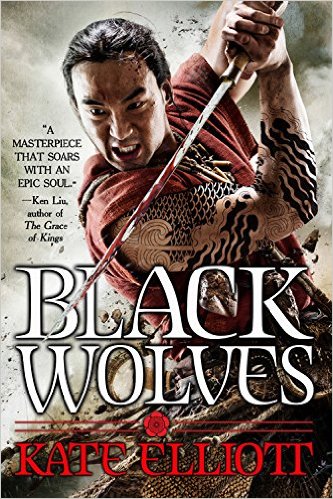
Black Wolves, by Kate Elliot. Published by Orbit Books.
Dust and Light, by Carol Berg. Published by Roc Books.

Set in the same universe as her Lighthouse duology, this book book can be easily read by someone unfamiliar with Flesh and Spirit and Breath and Bone (though those are well worth reading as well). Magic is hereditary in Berg's world, and sorcerers occupy a privileged, yet constrained position, as the use of their magic is controlled and contracted by the restrictive pureblood registry. The story centers around young Lucian de Remeni-Masson, a pureblood sorcerer who has been stripped of half his magic for unseemly conduct with an "ordinary." He and his sister are struggling to survive after the rest of their family was murdered by savage Harrowers. When he's forced to accept the contract of Bastien, master of the local dead house, Lucien's talent for creating portraits that tell the truth about the dead lands him in a world of trouble. Like with Berg's earlier books, the narrative is in first person and she does a fine job of portraying the voice and personality of her protagonist and making the reader care about him and his problems. The second book in this duo, Ash and Silver, was released in December, and I plan on reading it soon.

I don't read a lot of urban fantasy, but this author came to my attention when I attended the Cascade Writer's Conference in 2014. The protagonist, Finn Gramaraye, was framed for the crime of dark necromancy 25 years ago, and the story begins as he ends his exile from his body to the Other Side (an ethereal place of existence populated by the fey) and returns to his body, which has been helpfully occupied by a changeling to keep it alive during Finn's sentence, in the mortal realm. But the person who got him in trouble last time doesn't want him back in the mortal world, and Finn, with the help of his eccentric family, are going to have to find out what really happened and prove it to the Arcane Enforcers. The story has got a great voice and plenty of dark humor. The next book in the series, Bigfootloose and Finn Fancy Free, is coming out in February.
The Waking Engine, by David Eddison. Published by Tor Books.

This novel was published in 2014, but I didn't read it until last year. As someone who is a fan of classic fantasy, I wasn't sure if this book would appeal to me, but the author did a good job of drawing me into his basic premise, which is somewhat similar to that of the Riverworld series. When you die, you awaken in another world, where you live until you die again. Rinse, repeat. Until you awaken in the City Unspoken, which holds the gateway to true death. But Cooper is an anomaly. He seems to have skipped to the end of the line, and he awakens in the City Unspoken without ever having died at all (his navel from his "first birth" is still intact). He may be the only one who can solve a problem that threatens to unravel the metaverse: the gateway to true death seems to be malfunctioning and the Undying City is thronged with people who have nowhere else to go and are repeatedly dying and being reborn in the same place. Cooper is no kick-butt protagonist; he's more like an Arthur Dent--confused, bemused, and in over his head--but he never lost my sympathy. The author also made good use of the omniscient pov, something I haven't run across much in fantasy lately.
Subscribe to:
Posts (Atom)